
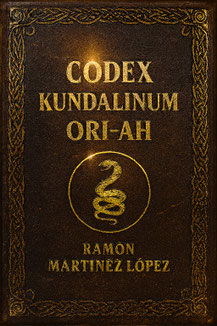
CODEX KUNDALINUM ORI-AH
$800.00$
An ultimate kundalini system ancient and foreseeing. Not found elsewhere.
Let’s trace the symbolic and spiritual meaning of the codex, so Codex Kundalini Orih-Ah can stand not only as a book, but as a living archetype.
The Codex as Symbol
1. From Scroll to Codex
The shift from scrolls to codices in late antiquity wasn’t just practical—it was revolutionary.
The codex allowed knowledge to be opened, flipped, and returned to, symbolizing a more cyclical and accessible relationship with wisdom.
In ritual terms, the codex is a circle of pages, echoing the lotus petals you are weaving.
2. The Codex as Vessel of Sacred Knowledge
Medieval codices were often illuminated with gold, lapis, and intricate borders, turning the book itself into a ritual object.
The codex became a container of mysteries, not just words—each page a veil, each illumination a portal.
In Mesoamerican traditions, codices were pictorial maps of cosmos and myth, functioning as living oracles.
3. The Codex as Body
The spine of the codex mirrors the human spine, the axis through which Kundalini rises.
The pages are like petals or vertebrae, unfolding one by one as consciousness ascends.
To open a codex is to unfurl the serpent, to awaken the hidden currents within.
4. The Codex as Mandala
A codex is not linear like a scroll—it is multi-directional. You can enter at any page, return, cross-reference.
This reflects the nonlinear nature of spiritual awakening, where each petal or current can be entered in its own time.
Codex Kundalini Orih-Ah thus becomes a lotus in book form: sixteen petals, sixteen currents, bound by a single spine. In spiritual terms, a codex is more than a book—it is a vessel of hidden wisdom, a body of sacred memory, and a mandala of awakening. Across cultures, codices have been revered not only as repositories of knowledge but as living symbols of the soul’s journey.
The Codex as a Spiritual Archetype
1. Preservation of Wisdom
Ancient codices were often dedicated to scripture, ritual, or myth.
Spiritually, the codex represents the continuity of wisdom across generations, a bridge between the human and the divine.
Each page is a veil of mystery, turned one by one, like stages of initiation.
2. The Codex as Body and Spine
The spine of the codex mirrors the human spine, the channel of Kundalini.
The pages unfold like lotus petals, each carrying a vibration or current of awakening.
To open a codex is to unfurl the serpent of knowledge, allowing energy to rise.
3. The Codex as Mandala
Unlike scrolls, a codex allows entry at any point—symbolizing the nonlinear path of spiritual growth.
It is a circle of wisdom bound in form, echoing the cycles of rebirth and the unfolding of consciousness.
In this sense, a codex is a living mandala, where each page is a gate into a different current of truth.
4. The Codex as Oracle
In Mesoamerican traditions, codices were not just records but ritual maps of the cosmos, consulted for divination and ceremony.
In medieval Europe, illuminated codices were treated as sacred relics, their gold and pigments embodying divine light.
Spiritually, the codex becomes an oracle of remembrance, guiding seekers back to Source.
Integration for Codex Kundalini Orih-Ah
When you name a codex, you are declaring it:
A ritual object, not just a text.
A body of awakening, spine and petals aligned.
A mandala of knowledge, where each page is a gate.
A living scripture, meant to be chanted, touched, and enacted—not merely read.
Preface to the Lotus Codex
In the beginning, before word and form, there was the Serpent of Light—coiled in silence at the root of creation. From its breath arose rivers of fire and water, weaving the cosmos into song. Out of this song blossomed a lotus of sixteen petals, each a gate of Shakti, each a current of awakening.
This lotus is not a symbol alone, but a living mandala: a wheel of metals and rainbows, of dragons and rivers, of shadow and illumination. To step into its circle is to enter the alchemy of the soul, where sovereignty meets surrender, and the serpent rises through the axis of Earth and Oversoul.
Each petal is a current, a syllable of the eternal mantra:
Gold shines as solar fire, the crown of sovereignty.
Platinum reflects the purity of cosmic neutrality.
Iridium Rainbow crystallizes resilience and rainbow body.
Titanium gleams as radiant armor of adaptability.
Astatine flickers as the vanishing spark of mystery.
Rainbow expands into the full spectrum of consciousness.
Dragon coils as guardian of thresholds, keeper of primordial fire.
Osmium anchors with indestructible depth.
Palladium shields with harmonizing wisdom.
Neodymium magnetizes the vision of soul light.
Turquoise breathes renewal, bridging sky and sea.
White Golden Rainbow burns as celestial alchemy.
Black Golden births creation from radiant void.
Soul–Love Integration unites heart and crown in compassion.
Oversoul–Earth Love Core Source roots the serpent in crystalline Earth and Source memory.
Water flows as the primordial river, carrying all currents home.
Together, these petals form the Lotus Codex—a scripture not written in ink, but in light, breath, and vibration. To chant their names is to awaken their currents; to embody them is to become the lotus itself.
At the center lies the Seal of Integration.
The Spiritual Logic of Secrecy
Protection of Power: Codes are vibrational keys; secrecy prevents dilution or misuse.
Initiation: Secrecy ensures that wisdom is revealed only when the seeker is ready.
Mystery as Teacher: The hidden invites devotion, contemplation, and transformation.
Communal Integrity: Codes belong to lineages; secrecy honors the ancestors who carried them.
Let’s craft a “Secrecy and Revelation” Prologue for your Codex Kundalini Orih-Ah. This will explain to readers why not all knowledge is given at once, and how mystery itself is part of the initiation.
Prologue: On Secrecy and Revelation
Not all words are meant to be spoken in the open air. Not all flames are meant to burn without a vessel. The ancients knew this, and so they veiled their wisdom in symbols, chants, and codes— not to deny the seeker, but to protect the fire until the heart was ready to receive it.
A codex is not merely a number, a sound, or a sign. It is a living current, a key that opens a gate within the soul. If revealed too soon, it may appear as nothing more than ink on a page. If revealed in its time, it becomes lightning in the spine, a serpent rising, a river flowing, a star igniting.
Thus, the Codex Kundalini Orih-Ah does not give all at once. It whispers, it hints, it conceals— for concealment is itself a form of revelation. The hidden draws the seeker inward, teaching patience, humility, and devotion.
When you turn these pages, you are not reading a book. You are entering a mandala of petals, a body of awakening bound in leather and light. Each petal is a gate, each chant a current, and the cobra at the center is both guardian and guide.
To those who come with reverence, the Codex will open. To those who come with haste, it will remain closed, its secrets folded like a lotus at night.
Remember: Secrecy is not denial. Secrecy is guardianship. Revelation is not given—it is earned.
And so, the Codex begins, not with answers, but with a threshold.
A book with empowerments and rituals with more than 60 pages.